
 中文 (中国)
 Tiếng Việt
 日本語
 한국어

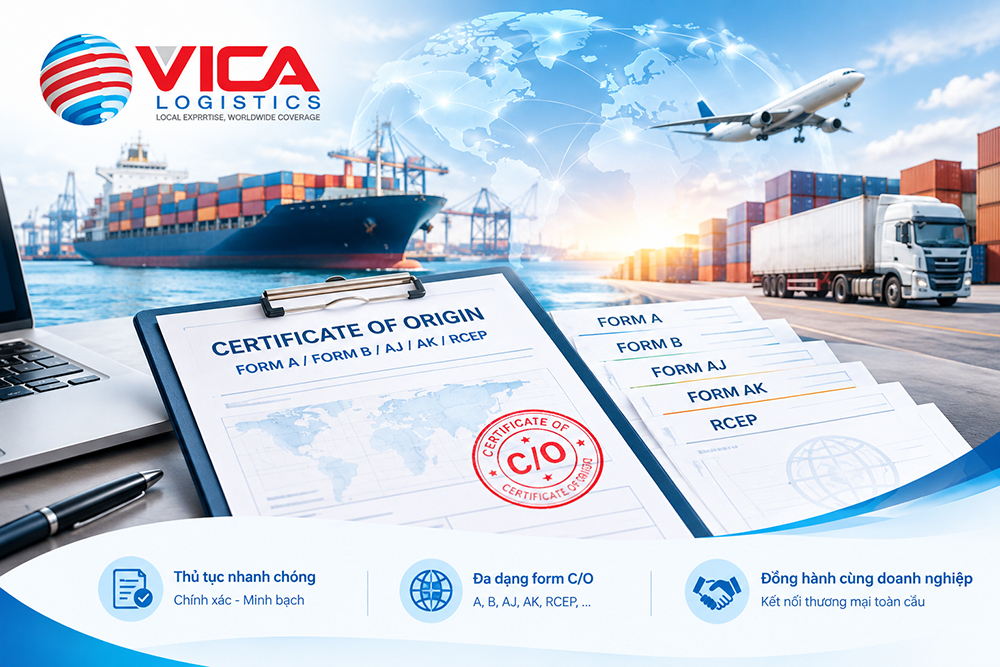
C/O (Certificate of Origin) is a certificate of origin for goods — one of the most important documents in international trade. A C/O not only confirms the country where goods were produced but also serves as the basis for businesses to enjoy tariff preferences under free trade agreements. This article explains what a C/O is, the common types of C/O, and key notes when applying for C/O for import-export goods.
What Is a C/O?
A C/O is a document issued by the competent authority of the exporting country, certifying that goods originate in a specific country or territory. In import-export, a C/O serves three main purposes: helping the importing country’s customs apply the correct tariff rate (especially special preferential rates under FTAs); meeting importer requirements or destination market regulations; and serving as evidence in trade disputes over origin.
Distinguished from C/Q (Certificate of Quality) and C/A (Certificate of Analysis), a C/O focuses solely on certifying origin, not product quality.
Common Types of C/O
Preferential C/O: Issued under free trade agreements to enjoy special preferential tariff rates, often much lower than MFN rates. Common forms in Vietnam include: Form E (ASEAN–China), Form D (ASEAN), Form AJ (ASEAN–Japan), Form AK (ASEAN–Korea), Form AANZ (ASEAN–Australia–New Zealand), CPTPP Form, EVFTA Form (exports to the EU), RCEP Form, UKVFTA Form (United Kingdom).
Non-preferential C/O: Confirms ordinary origin without special tariff preferences. Common forms: Form A (issued under the GSP generalized tariff preference scheme for exports to developed countries), Form B (Vietnamese origin, used across many markets).

Conditions for C/O Issuance
To obtain a C/O, goods must meet the rules of origin of each agreement, commonly the regional value content (RVC) criterion or HS code conversion. Businesses need to prepare: the cleared export customs declaration, commercial invoice, bill of lading, list of raw materials and production process, plus documents proving the origin of input materials.
In Vietnam, preferential C/Os are issued by the Ministry of Industry and Trade (through regional Import-Export Management Offices and authorized VCCI). Businesses must register their trader dossier for the first time before requesting C/O issuance for each shipment.
Common Mistakes When Applying for C/O
Frequent errors include: information on the C/O not matching the invoice or bill of lading (product name, quantity, value); declaring the wrong origin criterion; submitting dossiers late relative to the delivery date, causing importers to miss tariff preferences; and using the wrong C/O form for each market. These mistakes can lead to C/O rejection and significant loss of tariff benefits.
Professional C/O Application Services
With complex regulations varying by agreement, many businesses choose to authorize specialized C/O service providers. A reputable provider will advise on the right C/O form for each market, verify the validity of the dossier, work with the issuing authority on the business’s behalf, shorten processing time and ensure the C/O is valid from the first submission. Combined with all-in-one cargo customs clearance services, businesses can rest assured about import-export procedures.
Need a fast, compliant C/O application? Contact VICA Logistics via hotline +84-24-3266 6008 or email hanoi@vica.vn for advice on the right C/O type and service quotation.
