
 中文 (中国)
 Tiếng Việt
 日本語
 한국어

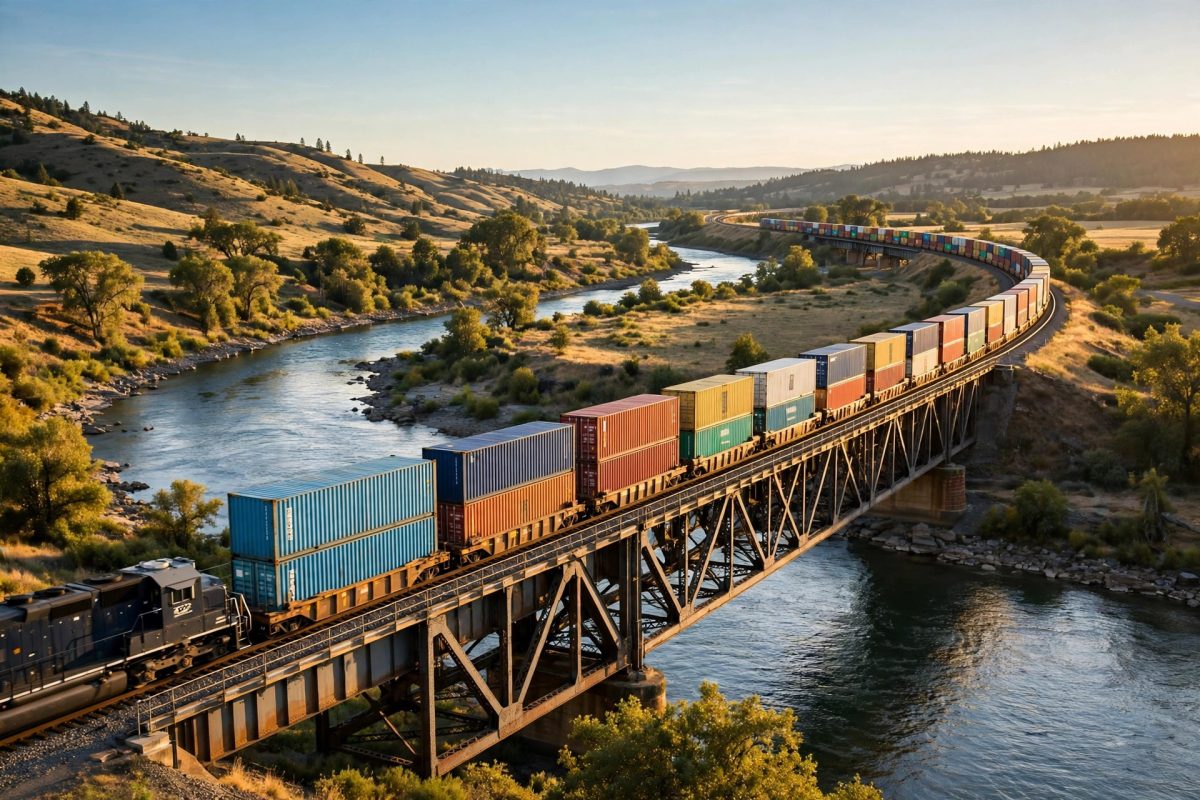
When sea freight is too slow and air freight is too expensive, many import and export businesses are turning to an option in between: international intermodal rail freight. This is the movement of goods by rail across borders, usually combined with road or sea transport for the first and last legs, forming a continuous door-to-door transport chain. Understanding how it works, its strengths and weaknesses, and the practical points to watch will help businesses decide whether this mode suits their shipment.
What is international intermodal rail freight?
International intermodal rail freight is the transport of goods by train through the territory of two or more countries, on a single unified journey and usually under one through bill of lading. Goods are loaded into standard containers, placed on wagons at the departure station, and moved on a fixed schedule to the destination station, where they are unloaded and forwarded by truck or by sea if needed.
The biggest difference between this mode and domestic rail freight is that goods must pass through rail border crossings, where customs procedures, cargo inspections, and possible transshipment take place due to differences in track gauge between countries. For Vietnam, the two main international rail border crossings are Dong Dang (connecting to Pingxiang, China) and Lao Cai (connecting to Hekou, China) — important gateways linking Vietnamese goods to the Asia–Europe intermodal rail network.
Advantages of intermodal rail freight
- Balanced speed: Significantly faster than sea freight and much cheaper than air freight, making it suitable for goods that need to be delivered within a medium timeframe, such as electronics, components, and seasonal consumer goods.
- Large volumes, stable costs: A single train can carry dozens of containers in one journey, keeping the cost per unit of cargo competitive, while the fixed train schedule helps businesses plan production and delivery with confidence.
- Less weather-dependent: Trains are less affected by storms, fog, or port congestion than sea and air freight, so schedules tend to be more reliable.
- Environmentally friendly: For the same cargo volume and distance, rail freight emits less than road and air transport, in line with the green logistics trend and the sustainability requirements of overseas partners.
Limitations businesses should know
Alongside its advantages, intermodal rail freight still has practical limits. First is the difference in track gauge: Vietnam uses narrow gauge on many lines, while China and Europe use standard gauge, so containers often have to be transferred to different wagons at border stations, adding time and handling costs.
Second, the route network is still limited: not every location has an international rail station, and businesses usually need additional road transport for the first or last leg. Third, some cargo types such as dangerous goods, refrigerated goods, or oversized cargo require specialised containers and wagons, which not every train can provide. Finally, goods transiting through several countries must comply with the customs regulations and documentation of each country, demanding thorough preparation of paperwork.
The process of shipping a consignment by intermodal rail
1. Booking and cargo preparation
The shipper books space on a train through a forwarder or rail transport operator, confirming the departure station, destination station, schedule, and the container type suited to the cargo. Goods are packed, securely lashed, and labelled in accordance with regulations.
2. Export customs declaration
The customs declaration is completed in the country of export before the goods are loaded onto the train. Documents such as the rail waybill, commercial invoice, packing list, and certificate of origin (if preferential tariffs apply) must be prepared in full.
3. Transport and transit
The train moves according to schedule, stopping at border stations for transit procedures and transshipment if the track gauge changes. Shippers can track the journey using the waybill number or the carrier’s tracking system.
4. Import clearance and last-mile delivery
When the train reaches the destination station, the goods are cleared through import customs and handed over to the consignee or forwarded by truck to the company’s warehouse, completing the door-to-door transport chain.
What should businesses consider when choosing a rail route?
- Compare total cost and time: Do not compare train freight alone; include transshipment costs at border stations, first- and last-mile transport, documentation fees, and storage charges.
- Check schedules and frequency: Some routes run only a few services a week; businesses should book early in peak season and allow extra time for procedures at border crossings.
- Choose the right container type: Dry cargo uses standard containers, temperature-controlled cargo uses reefer containers with power supply on the train, and oversized cargo needs specialised wagons and must be confirmed in advance.
- Prepare complete transit documentation: Cargo passing through several countries needs a through waybill and customs documents matching each transit country to avoid being held at the border.
- Buy cargo insurance: Although rail is relatively safe, businesses should still insure high-value shipments, especially when the journey crosses several countries.
Conclusion
International intermodal rail freight is becoming an important link in the modern supply chain, especially on routes connecting Vietnam with China and further on to the European market. This mode offers a sensible balance between cost, time, and sustainability, and is particularly suitable for businesses that need delivery faster than sea freight while still keeping their budget under control. As rail infrastructure and intermodal procedures continue to improve, it will be a choice worth considering in the logistics strategy of many import and export businesses.
